
Breed Info
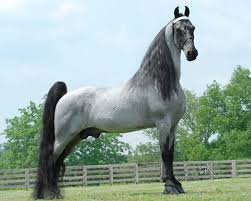
Tennesse Walking Horse
The Tennessee Walking Horse is renowned for his ability to perform a smooth, 4-beat lateral gait, similar to other breeds of horses, except more quickly timed, and they're BORN that way! Yes, the first steps they take are "gaited steps" -- no training or devices needed. The Tennessee Walking Horse performs three distinct gaits: the flat foot walk, running walk, and canter. The horse glides over the track left by the front foot with the hind foot, which is known as 'overstride'. A true-gaited Tennessee Walker will nod his head in rhythm with the cadence of his feet, and sometimes flop their ears with each nod. Most walking horses are capable of performing a regular slow walk like any other breed, a "flat walk" (the first gait), a "running walk" (the 2nd gait, which can be as fast as 10 mph) and then the canter. Walking horses are also known for their beautiful 'carousel' canters, rising and falling slowing and smoothly. Other gaits that can be performed by some Walkers are the pace, rack, foxtrot, and single-foot.
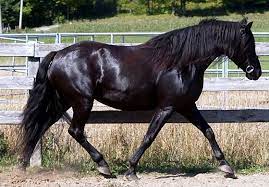
Canadian Pacer
This light breed of pleasure horse was bred to work in the fields during the week, especially to ride the turn rows on the plantations in the south, but be a smooth ride on the weekends for pleasure. A fusion of Thoroughbreds, Canadian Pacers, Saddlebreds, Morgans, American Standardbreds and Narragansett Pacers, this docile servant evolved in the middle Tennessee bluegrass region, and therefore christened the "Tennessee Walking Horse". The Tennessee Walker's size ranges from 14H to 17H, with the average being from 15H to 15.2H. From the 1930's, this gentle breed was known for having rather large, coarse heads, but through the years, especially due to the influence of "Pride of Midnight", a son of the 1945, 1946 World Grand Champion "Midnight Sun". We believe the beautiful head began with him, and most Walkers today are much more refined and pretty than their ancestors. Colors are almost limited to your imagination! Walkers are black, sorrel, chestnut, grey, roan, bay, buckskin, champagne, palomino, cremello and spotted (sabino, tobiano and overo).
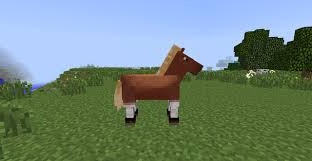
Horse
Horses wander aimlessly, occasionally stopping to rear, flick their tails, or lower their heads as though eating the grass. Unlike sheep, the eating animation does not actually cause any grass to be consumed. If a human comes near, the horses may turn to look at them. Any horse, even a wild or undead horse, can be attached to a lead without protest, although an untamed horse rears and flails its forelegs if saddled. Horses remain passive, even when hit.